
Competitive Landscape & The Moat
The nature-data market is crowded, but the crowd clusters into a few archetypes, and the one position that matters is almost empty.
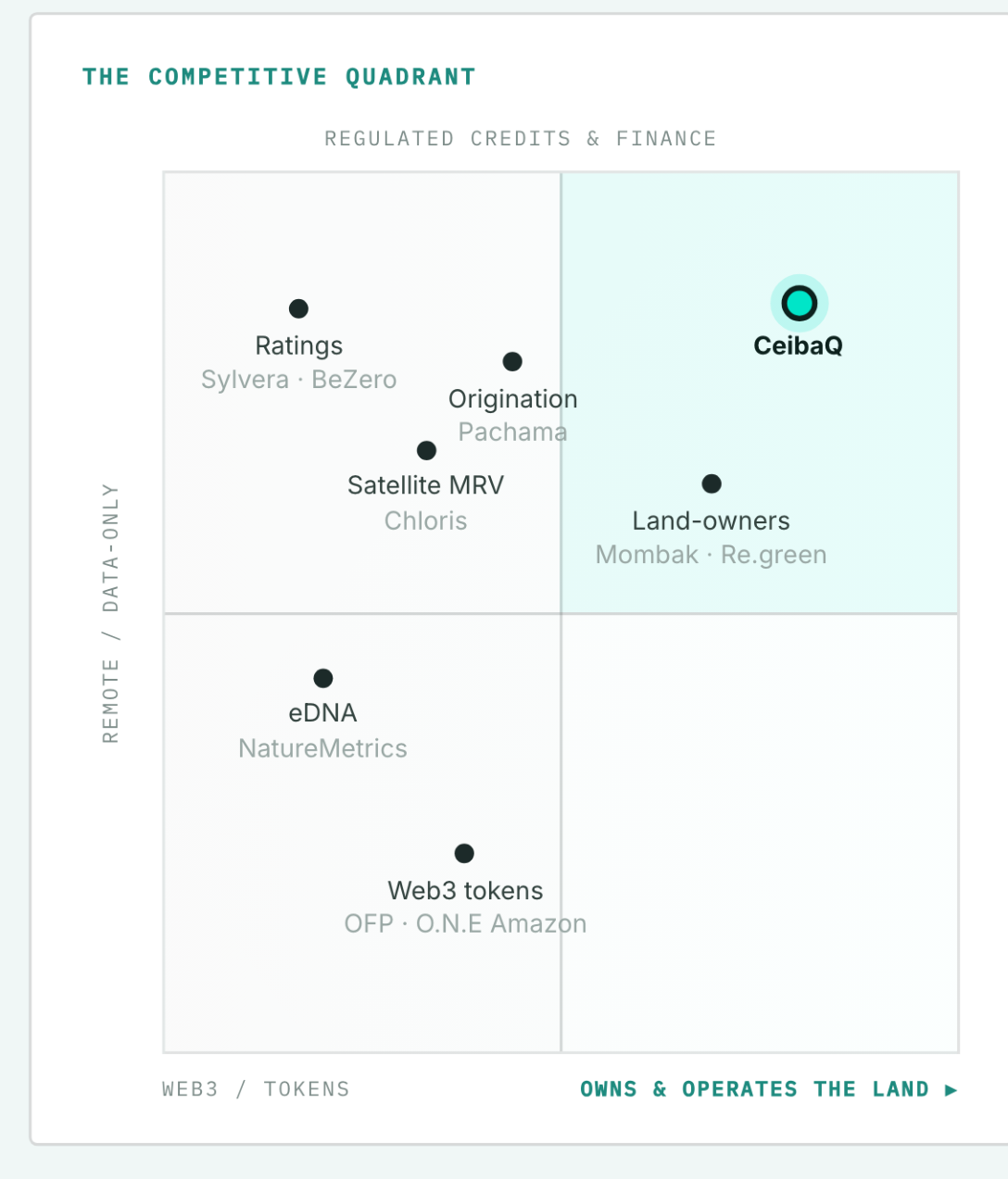
The map
Place every player on two axes. One runs from reading nature remotely to owning and operating the land it is measured on. The other runs from regulated credits and finance to Web3 tokens. Most of the field sits in the remote, data-only half: rating agencies score credits from a desk, satellite firms map the canopy from orbit, and a cluster of crypto projects tokenise forests. A few origination companies own land but sell carbon only, with no measurement layer of their own. The quadrant that combines owned ground, regulated multi-credit instruments and a proprietary measurement layer is, today, effectively empty. That is where CeibaQ sits.
Who is in the market
| Archetype | Players | Raised to date | What they lack |
|---|---|---|---|
| Carbon-credit ratings | Sylvera, BeZero | ~$95M · ~$109M | their own ground truth; they rate from a desk |
| Satellite MRV | Chloris (Planet is public) | ~$18M | they see the canopy, not what is beneath it |
| Biodiversity / eDNA data | NatureMetrics | ~$52M | one signal, not a multi-credit layer; no concession |
| Carbon origination & marketplace | Pachama (acquired by Carbon Direct, 2025) | ~$88M | an analytics layer, not owned field measurement |
| Land-owning originators | Mombak, Re.green | ~$30M · ~$76M | a measurement and evidence layer |
| Web3 tokenisation | Open Forest Protocol, O.N.E Amazon | ~$4M | regulated standing; crypto, not compliance |
Figures are capital raised to date, not valuations.
The pattern is consistent: the field is well funded — the data and ratings players each raising $50–110M — yet none owns the under-canopy, field-calibrated layer the regulated market increasingly requires.
Why capital alone cannot copy it
A funded competitor can buy the same satellites and the same sensors, but three things are not for sale. The Amazon's under-canopy state — its species, soil and degradation — cannot be read from orbit and has to be measured on the ground, season by season. The signed evidence chain, from a field measurement to a cryptographically provenanced claim, is a system, not a feature. And the concession access and the twenty years of state data are granted through relationships, not bought on the open market. Capital shortens none of these.
"Macro AI models that generalise across markets are only viable when built on large, high-integrity data sets." — Ryan Arseneau, CEO, CarbonAI
Competitors become customers
Because they read nature from a distance, the players above need the ground layer they cannot build. The rating agencies need field truth to defend their scores; the satellite firms need calibration their models lack; the originators need a measurement layer to make their land bankable. CeibaQ sits upstream of all of them — neutral, under every standard (Verra, ART-TREES, Article 6.2, SEEA) — and licenses the proof they depend on. The commitment by Google, Meta, Microsoft and Salesforce to buy only independently verified removals, not bulk carbon, is the same signal: the market is paying for verified data, not volume.
"The majority of the methodologies actually prohibit the use of satellite remote-sensing data." — David Marvin, Planet Labs (the carbon standards require ground-based measurement; satellite data alone is not accepted as sufficient)
"We combine satellite optical imagery, LiDAR data, and field plot data that is used as ground truth to improve the accuracy of the model." — Diego, Pachama
The exit it points to
The market is consolidating around exactly this. Carbon Direct's acquisition of Pachama in 2025 shows incumbents buying the capability they lack. A ratings or data leader that needs ground truth for the Amazon is a natural acquirer of the layer CeibaQ builds.
The honest risk
The incumbents carry real advantages: far more capital and established buyer relationships, against a CeibaQ that is pre-revenue and unproven at commercial scale. The voluntary carbon market is also still recovering its credibility after 2023. And new entrants could expand into the space — the EU deforestation-compliance tools, the large ESG-data houses, and government MRV programs among them. The mitigant is the regulated tailwind and the first signed contract: as the EU deforestation rules, Article 6.2 and corporate disclosure all begin to require ground-verified data, the players who read the forest from afar move from being able to ignore CeibaQ to needing it, and GATE 0 is what turns that from a thesis into a position.
The quotations are public remarks from the IETA LIVE webinar "Leveraging AI for the Future of Carbon Markets" (2026).