Product Overview — What CeibaQ Sells
CeibaQ sells a signed evidence artifact: a precise, defensible statement about the condition of a specific place. It says how much carbon that place holds and how that is changing, the state of its biodiversity, the degradation hidden under the canopy, and the health of its water. Each claim carries the confidence around it, where the evidence came from, and the exact version of the method and model that produced it. It is built so that accredited third parties can verify it independently. We describe our data as quantified and independently verifiable, never as self-verified.
The same artifact serves every market at once. One dataset supports carbon, biodiversity, water and resilience instruments, in the native format of any registry or standard it has to feed: Verra, ART-TREES, Article 6.2, CORSIA, SEEA. CeibaQ is built for compatibility with these frameworks, not endorsement by them. That is what makes it infrastructure rather than a vendor: not one product for one buyer, but the single source of evidence the whole market draws from.
The Terminal — where the evidence lives
The evidence is delivered two ways: as an API into a customer's own systems, and through the CeibaQ Terminal, the live working product where the same signed record can be seen, questioned, drilled into and exported. The Terminal is not a mock-up — it is the working build, and every investor can open it and click through every layer.
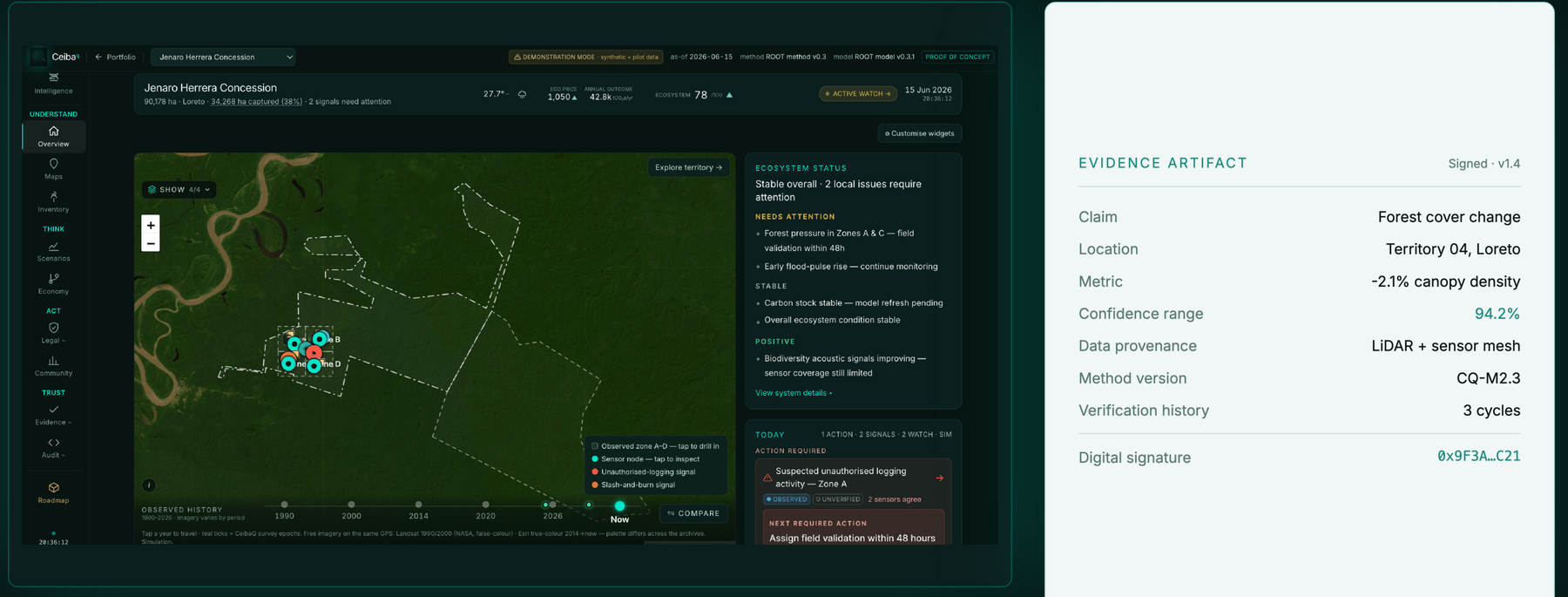
Each territory opens as its own workspace, organised the way a decision-maker actually reads a place:
- Overview — the living territory at a glance: the real concession on a satellite base with the observed history 1990→now, the ecosystem-status briefing (what is stable, what needs attention, what is improving), the action queue, the headline systems (forest, carbon, biodiversity, water) and the field micro-station.
- Maps — the cartography layer: drone-LiDAR canopy-height, scan coverage, ecosystem strata and degradation heat, drawn over the real ground.
- Inventory — the valuable-species cadastre from drone canopy identification (exact positions RBAC-masked for the authority).
- Scenarios — forward-looking risk pathways and time-bound warnings for the territory: scenarios, not predictions.
- Nature Economy — the natural-capital account and the verified-outcome-to-credit lifecycle, mirroring third-party registries and venues by API. CeibaQ does not issue, verify or trade; it measures the outcome and shows where each quantity sits in its lifecycle.
- CeibaQ Intelligence — ask a territory a question in plain language and get a structured, evidence-grounded answer that can never contradict the underlying records; refuse-by-default, never a legal finding.
- Legal cabinets · Community · Evidence · Audit & API — the same signed evidence scoped to each institution's mandate (MINAM · GORE Loreto · SERFOR · OSINFOR), the community co-governance surface, and the signed-artifact inspector, verification pack, registry-native exports and API keys.
Signed artifacts are the output
Whether it arrives by API or is opened in the Terminal, the unit of value is the same: a signed evidence artifact. Every value carries its confidence interval, its data provenance, and the method and model version that produced it; before release each one passes the model's quality checks and is cryptographically signed with its full provenance, so a customer — or their independent verifier — can trace it from the field measurement to the claim. The Terminal is how a human reads that evidence; the API is how a system consumes it; the signed artifact is what both deliver.
How you engage
What CeibaQ does for that evidence depends on the engagement. In its lightest form the product is a licence to the verified data layer: the customer queries the reference model through the API and receives signed evidence for their area, with no field work on their side. In its fuller form CeibaQ also goes to the ground: it flies drone surveys, installs sensor nodes, samples environmental DNA, and in some cases sends teams to measure and verify conditions on site, then delivers the same signed evidence. The jurisdictional and monitoring lines usually include this field work; the enterprise data licence usually does not. In every case the customer receives the signed evidence; what varies is how much of the measurement CeibaQ performs for them.
What we do not sell
The product is the evidence, never the machine that makes it. CeibaQ operates the model itself and sells what it produces, including monitoring delivered as a service. It does not sell or license the reference model, the raw measurements, the model's coefficients, direct access to run or query the model, or its data as a corpus for training other companies' AI. Every licence carries a no-training, no-reconstruction clause. Selling the model or the raw data would hand competitors the one input they cannot build, break the neutrality the evidence layer depends on, and turn a pure-data company into a lower-value infrastructure one. We license the signed evidence and the verified layer behind it, and nothing underneath.
The asset behind the product. Every artifact the Terminal delivers is produced from ROOT, a calibrated reference model of the Peruvian Amazon — built once and reused many times. ROOT is the infrastructure; the signed artifact is the product. How ROOT is built — the instruments, the sensing stack and the fusion method — is in Architecture & Hardware.